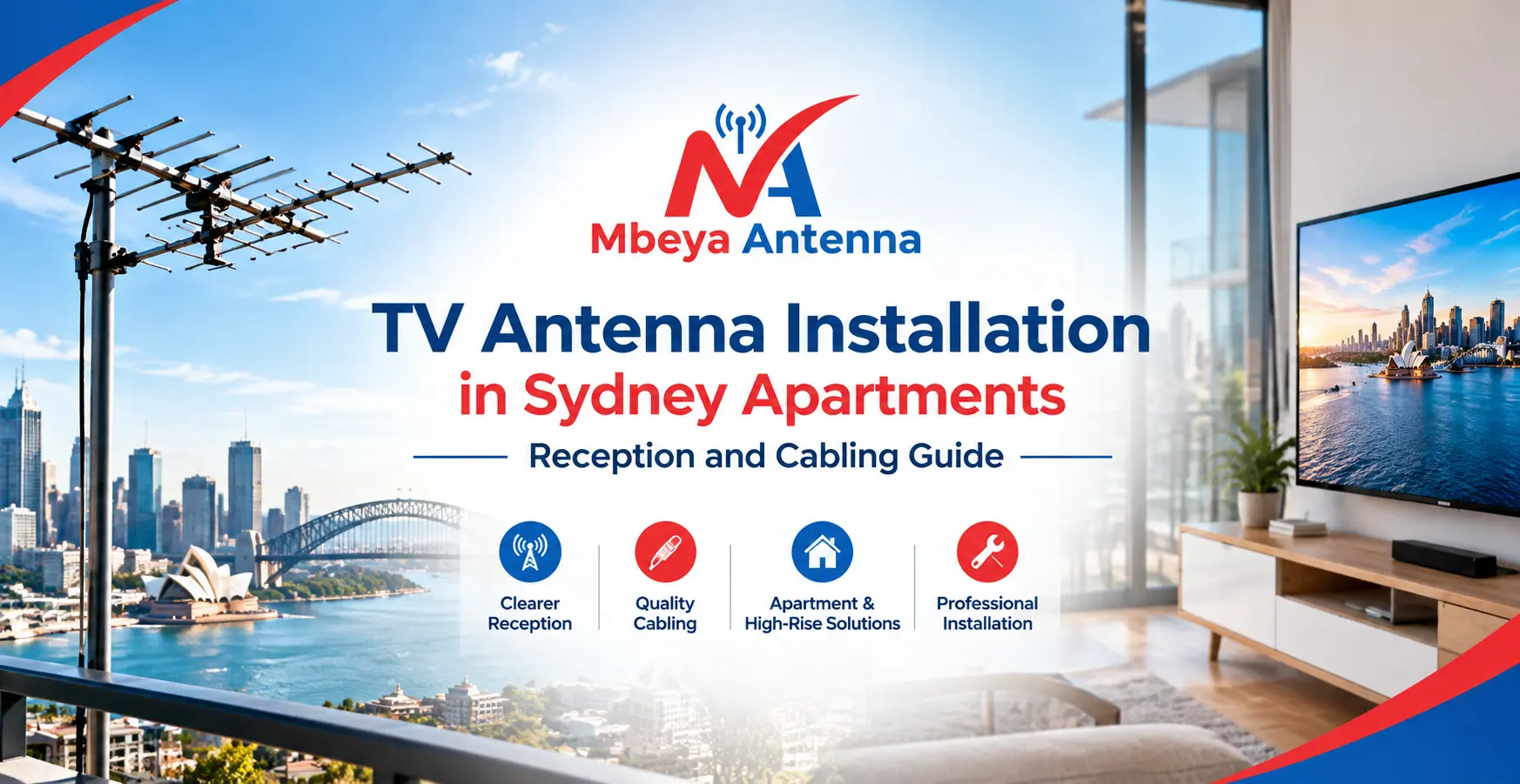
If you live in a Sydney apartment and your TV keeps pixelating, losing channels or showing a weak signal, the antenna itself may not be the problem. TV reception in apartments depends on the antenna, building structure, signal direction, cabling, splitters, wall outlets and sometimes a shared building antenna system. In many cases, fixing one weak connection or damaged section of coaxial cable can solve the problem without replacing the entire antenna.
For a new TV antenna installation in a Sydney apartment, the first step should be identifying how your building receives free-to-air television. Some apartments have an individual antenna, while others rely on a communal Master Antenna Television (MATV) system that distributes TV signals throughout the building. The right solution therefore depends on your apartment, building design and existing infrastructure.
The Australian Communications and Media Authority (ACMA) recommends checking the expected reception for your address, antenna configuration, transmitter direction and channel frequencies through its mySwitch service. ACMA also identifies antenna condition, cabling, connections, signal amplification and interference as common causes of reception problems.
For Sydney apartment owners and tenants, this means better TV reception starts with diagnosis rather than simply buying a bigger antenna.
Can you install a TV antenna in a Sydney apartment?
Yes, but the installation method depends on the building. An apartment may already have access to a communal antenna system, an existing wall outlet connected to a MATV distribution network, or an individually installed antenna serving the property. Before installing anything on a balcony, exterior wall, roof or other common area, residents should also check their strata or building requirements.
An individual antenna can sometimes be installed where the apartment has suitable access and the signal conditions support it. However, high-rise buildings create additional challenges because surrounding buildings, concrete slabs, metal structures, tinted windows and internal walls can affect signal propagation. A balcony that appears to have a clear view may not necessarily provide the strongest or cleanest TV signal.
The practical question is therefore not simply, “Which TV antenna should I buy?” It is “How is my apartment currently receiving the TV signal, and where is the signal being lost?” A professional assessment can identify whether the issue originates at the antenna, wall outlet, cable, splitter, amplifier or shared building system.
Mbeya Antennas & Digital Solutions provides TV antenna installation, repairs, TV points, high-rise solutions and commercial antenna systems across Sydney and surrounding suburbs. Its service offering also includes MATV systems for multi-tenant apartment buildings.
Why apartment TV reception can be difficult in Sydney
Sydney has a mixture of high-rise apartments, older brick buildings, newer developments, townhouses and densely packed residential areas. Each building can create a different reception environment. Two apartments only a few streets apart can experience different signal quality because antenna position, building height, surrounding structures and internal cabling are not identical.
Digital TV reception can also fail in a way that looks confusing to the homeowner. Instead of gradually becoming worse, a digital signal may appear perfectly normal and then suddenly pixelate, freeze or disappear when signal quality falls below what the receiver can reliably decode. That is why a TV displaying some channels clearly does not necessarily mean the whole antenna system is healthy.
ACMA advises checking the local transmission information, antenna setup and equipment before assuming that an external interference problem exists. Its current reception guidance specifically identifies damaged antennas, incorrect positioning, faulty cables, connectors, splitters and unnecessary amplification as possible causes.
For apartment residents, another important factor is the shared infrastructure. If several residents experience the same reception problem at approximately the same time, the fault may be somewhere in the building’s common antenna or distribution system rather than inside one apartment.
How building materials affect TV signals
Building materials can act like obstacles between your antenna and the broadcast signal. Reinforced concrete, steel structures, metal cladding, foil-backed insulation and certain types of energy-efficient glazing can all influence radio-frequency signals. The higher the building density around an apartment, the more complicated the signal path can become.
This is one reason an indoor TV antenna can work surprisingly well in one apartment but perform poorly in another. A window-facing apartment on an upper floor may have very different reception conditions from an apartment surrounded by neighbouring towers.
Furniture and electronics can also influence indoor reception. Fix TV Antenna’s recent Sydney-focused guidance notes that indoor antennas can be suitable for apartments and other properties with strong signals, while walls, furniture, electronic equipment, windows and neighbouring buildings can weaken reception.
A professional assessment should therefore consider the actual location of the TV and antenna rather than relying only on the advertised gain of an antenna.
Indoor vs outdoor TV antennas for apartments
An indoor antenna can be a convenient option for an apartment, particularly where the local signal is already strong. It avoids roof access and may be appropriate for renters or residents who cannot make changes to common property. The downside is that the antenna is operating inside an environment that may reduce or distort the available signal.
An outdoor antenna generally provides more flexibility because it can be positioned in a location with fewer obstacles. However, apartment residents cannot automatically assume that they can attach an antenna to a balcony, external wall or roof. Strata rules, building management requirements, access restrictions and common-property considerations can all affect the installation.
| Option | Potential advantage | Potential limitation |
|---|---|---|
| Indoor TV antenna | Simple and suitable for some apartments | More affected by walls and nearby objects |
| Individual outdoor antenna | Better positioning flexibility | May require approval and suitable access |
| Shared MATV system | Designed to distribute TV to multiple apartments | Faults can affect multiple outlets |
| Professional signal assessment | Identifies the actual reception problem | Requires an installer visit |
The important point is that higher antenna gain does not automatically mean better reception. An antenna can receive a strong signal but still produce unreliable television if interference, multipath effects, poor cabling or excessive amplification affects signal quality.
ACMA recommends checking the antenna’s suitability for the local frequencies, position, direction and expected coverage rather than selecting equipment based only on marketing claims.
Do apartments need a new antenna or a shared system?
Many apartment residents assume they need a new antenna when the real issue is the building’s shared distribution system. A MATV system can take signals from a central antenna and distribute them through amplifiers, splitters and coaxial cabling to individual apartments and TV outlets.
This arrangement is particularly useful in multi-storey residential buildings because installing an independent rooftop antenna for every apartment would be inefficient and may create unnecessary infrastructure. Mbeya Antennas specifically lists commercial MATV, high-rise systems and apartment building antennas among its commercial antenna services.
If only your apartment has a problem, the technician may start by checking the wall outlet, fly lead, internal cable, splitter or apartment-level connection. If several apartments are affected, the investigation may move toward the central distribution equipment.
This distinction matters because replacing the TV antenna will not necessarily solve a faulty distribution amplifier or damaged cable. A professional diagnosis helps avoid spending money on equipment that does not address the actual fault.
TV antenna cabling: what apartment owners should know
TV antenna cable is just as important as the antenna itself. A good antenna cannot compensate for a damaged, poorly terminated or unsuitable cable path. Coaxial cable carries the RF signal from the antenna or distribution system to your television, and losses accumulate as the signal travels through cables, connectors and splitters.
ACMA’s current reception guidance recommends checking cables and fly leads for damage, excessive length and poor condition. It specifically recommends RG6 quad-shield coaxial cable for connecting an antenna to a TV. ACMA also warns that unnecessary splitting can reduce signal levels and that amplifiers should only be used when necessary.
Apartment cabling can be more complicated than a single house installation because cables may travel through walls, ceiling spaces, risers, communications cupboards and shared distribution points. If a cable is concealed inside a building, residents should avoid cutting into walls or modifying fixed cabling without understanding the building’s requirements.
Australian customer cabling work is regulated. ACMA states that registered cablers must perform or supervise regulated cabling work and comply with the applicable cabling rules and AS/CA S009:2020 Wiring Rules. The current Telecommunications (Cabling Provider) Rules 2025 also require a written certification statement after completed cabling work.
How to diagnose poor TV reception in an apartment
Before replacing equipment, look at the symptoms. If every channel is affected, the problem could be related to the antenna, distribution system, amplifier or main cable. If only one or two channels disappear, the problem may be frequency-specific, interference-related or connected to the way the system is configured.
Start by checking the TV’s cable connection and fly lead. A loose connector can create intermittent reception that looks like a complicated antenna fault. If possible, test another TV outlet in the apartment; this can help determine whether the problem follows the TV or remains tied to one wall point.
Next, consider whether your neighbours have the same issue. ACMA recommends checking with neighbours when investigating reception problems because a shared fault or external interference can affect multiple properties.
A professional installer can go further by measuring the signal rather than relying solely on the picture displayed by the TV. ACMA’s installer guidance identifies measurements including signal level, CBER, VBER and MER when diagnosing digital TV reception. It states that signal levels at wall plates should generally be around 54 dBµV, with levels below 45 dBµV or above 80 dBµV unsuitable for TV reception.
Should you use a TV signal booster or amplifier?
A booster can be useful, but a signal amplifier is not a universal cure for poor TV reception. If the incoming signal is already weak or heavily affected by interference, increasing the amplification can also increase unwanted signals or overload the television receiver.
ACMA specifically warns that signal boosters or amplifiers should only be used when necessary. It also notes that excessive amplification can overload the receiver with TV or mobile phone signals and may contribute to interference.
This becomes particularly important in apartment buildings with multiple outlets. A shared distribution amplifier may be required to compensate for cable and splitter losses, but the system needs to be balanced. Too little signal can cause dropouts; too much can also create reception problems.
A professional technician should therefore measure the system before deciding whether an amplifier is required. The goal is not simply to achieve the highest possible signal number. The goal is a stable signal with appropriate level and quality at the television outlet.
When is a 4G/5G filter needed?
Mobile network signals can sometimes interfere with television reception, particularly when amplification equipment is involved. ACMA says reception problems can be more likely where a viewer is within about 1 km of a mobile phone tower and has a signal amplifier.
A 4G/5G filter can help prevent unwanted mobile-frequency signals from entering the television reception system. However, installing a filter should also be based on diagnosis rather than assumption.
If your TV reception suddenly becomes unreliable across many channels, especially after changes to nearby equipment or an existing amplified system, mobile interference can be one possibility. Other causes include damaged cabling, faulty splitters, antenna movement, local electrical interference and problems within the building’s distribution network.
A technician can test the signal and determine whether filtering, amplification, antenna adjustment or cable replacement is appropriate.
What professional apartment antenna installation involves
A quality TV antenna installation in Sydney apartments should begin with an assessment rather than immediately mounting hardware. The installer needs to understand the building configuration, determine the available signal path and identify whether the apartment uses an individual or shared antenna system.
The next stage is equipment inspection. This can include checking the antenna, mast or mounting hardware, coaxial cable, wall outlets, splitters, distribution amplifiers, connectors and TV connection. Where reception is poor, signal measurement can help identify the exact point where performance is being lost.
Installation work can then include antenna positioning, cable replacement, new TV points, connector termination, splitter configuration or distribution-system adjustments. Once the physical work is complete, the system should be tested at the relevant outlet or outlets.
Mbeya Antennas describes its process as consultation, expert advice, professional installation and testing of the completed system. Its Sydney service also covers residential and commercial antenna work, including high-rise and MATV solutions.
For a customer, the biggest benefit of this approach is simple: the installation is based on the property’s actual reception conditions rather than a generic equipment recommendation.
Apartment strata and common-property considerations
Apartment antenna work can involve more than technical considerations. In many buildings, roofs, external walls, risers, communications rooms and shared antenna infrastructure are common property or controlled by the owners corporation or building manager.
That means a resident should check the building’s rules before arranging work that affects common areas. A technician may need access to a shared communications cupboard or rooftop antenna system, and the work may need coordination with strata management.
For example, installing an individual antenna on a balcony might appear straightforward, but the balcony structure, external appearance or cabling route may be subject to building rules. Similarly, replacing a shared amplifier is different from repairing a TV point inside one apartment.
A good installer should be able to explain what can be addressed within the apartment and what may require coordination with strata or building management. This is especially important for high-rise properties where one infrastructure fault can potentially affect multiple residents.
How to choose a TV antenna installer in Sydney
When searching for TV antenna installation near me, avoid choosing an installer based solely on price or a promise of the “strongest antenna.” Reception depends on the property, and professional workmanship involves diagnosis, correct equipment selection, safe installation and testing.
Ask whether the installer can test signal strength and quality, identify the source of reception problems and explain whether your property uses an individual antenna or shared MATV system. You can also ask about registration, relevant competencies, workmanship warranty and what documentation will be provided after regulated cabling work.
ACMA advises customers to make sure the cabler is registered and says customers can ask to see proof of registration. It also states that a registered cabler should provide a signed written statement certifying that regulated cabling work complies with the Wiring Rules.
Mbeya Antennas states that it has experienced technicians and provides residential and commercial antenna services across Sydney and surrounding suburbs. Its website also identifies antenna installation, high-rise solutions, TV mounting and commercial MATV among its services.
TV antenna installation for multi-room apartments
A single television may need only one reliable cable path, but multiple TVs introduce additional signal-distribution considerations. Every splitter, connector and cable length can contribute to signal loss, which means a system that works for one outlet may not perform the same way when expanded to three or four rooms.
This is where professional planning becomes useful. The installer can determine the incoming signal level, calculate distribution requirements and select appropriate splitters or amplification equipment where necessary. The aim is to provide suitable reception at each outlet without unnecessarily over-amplifying the system.
For apartment buildings, the same principle applies on a larger scale. MATV systems can distribute television signals to many dwellings, but the central equipment and cabling need to be designed and maintained correctly.
If you are adding a second or third TV to an apartment, it is therefore worth checking the existing system before purchasing a booster or splitter. The existing outlet may already be connected to a shared distribution network, or the apartment may need a properly configured additional TV point.
When to repair existing cabling instead of replacing the antenna
Replacing an antenna is not always the right answer. If the antenna is in good condition and correctly positioned, the problem may be further down the signal path.
Look for symptoms such as one TV working while another does not, a problem appearing after moving furniture or equipment, intermittent reception, visible cable damage or a loose wall connection. These clues can indicate a cabling or connection problem rather than an antenna failure.
ACMA states that many TV reception problems are associated with antenna setup, cabling or equipment. Its current guidance recommends checking cables, fly leads and connections and using appropriate coaxial cable.
Repairing the correct component can be more practical than replacing an entire system. A technician may find that a connector needs re-termination, an old cable needs replacement, a splitter is faulty or an amplifier is unnecessary.
This diagnostic approach is particularly valuable for apartments because shared infrastructure can make a simple-looking reception problem more complicated than it first appears.
TV antenna installation across Sydney and surrounding suburbs
Sydney apartment residents can encounter reception problems in many different types of properties, from older low-rise buildings to modern high-rise developments. Mbeya Antennas provides antenna and digital connectivity services across Sydney and surrounding suburbs, with services covering residential and commercial properties.
Its broader antenna offering includes TV antenna installation, repairs, TV points, high-rise solutions and commercial MATV systems. This makes the service relevant not only to individual apartment residents but also to property managers, strata properties and multi-dwelling buildings that need a shared television distribution solution.
Whether the requirement is a new antenna, an additional TV point, reception troubleshooting, cable replacement or a shared apartment antenna system, the sensible starting point is an assessment of the existing infrastructure.
For Sydney customers searching for TV antenna installation near me, Mbeya Antennas offers professional advice and on-site service across Sydney and surrounding areas. The business lists phone support at 0490 765 009 and provides a free quote option through its website.
Conclusion
Reliable apartment TV reception is rarely just about buying the biggest or most expensive antenna. The result depends on the complete signal path: antenna, positioning, building environment, coaxial cable, connectors, splitters, amplifiers, wall outlets and, in many buildings, a shared MATV distribution system.
If your Sydney apartment has pixelation, missing channels or intermittent reception, start by identifying where the signal is being lost. Check the existing setup, consider whether other apartments are affected and have the system professionally tested before replacing equipment.
ACMA’s current guidance supports this diagnostic approach, including checking local reception information, antenna condition, cabling, amplification and interference.
For apartment residents, landlords, strata managers and commercial property owners, professional installation can also make the difference between a temporary fix and a properly tested system. Mbeya Antennas & Digital Solutions provides antenna installation, repairs, high-rise antenna solutions, TV points and MATV services across Sydney and surrounding suburbs.
If you’re experiencing reception problems, don’t assume the antenna is the culprit until the complete system has been checked. Sometimes the solution is a new antenna. Sometimes it is a cable, connector, outlet or distribution component. Testing first helps you spend money on the part that actually needs attention.
FAQs
Can I use an indoor TV antenna in a Sydney apartment?
Yes. An indoor TV antenna can work well in an apartment where the available TV signal is sufficiently strong and the antenna can be positioned effectively. However, concrete walls, neighbouring buildings, windows, furniture and electronic equipment can affect reception. If an indoor antenna produces unstable reception, a professional assessment can determine whether repositioning, an external antenna or connection to a shared building system would be more suitable.
Why does my apartment TV keep pixelating?
Pixelation can result from insufficient signal level, poor signal quality, damaged coaxial cable, loose connectors, faulty splitters, antenna positioning, interference or problems with a shared apartment antenna system. ACMA recommends checking the antenna, cabling, equipment and local reception conditions before investigating external interference.
Do I need a signal booster for multiple TVs?
Not necessarily. Multiple TVs can increase signal-distribution losses, but a booster should only be installed when testing shows that amplification is appropriate. ACMA warns that unnecessary amplification can overload a receiver and potentially contribute to interference.
Can an antenna installer fix existing apartment cabling?
A qualified and appropriately registered cabler can perform regulated cabling work within the scope of their registration and competencies. ACMA states that registered cablers must comply with the Telecommunications (Cabling Provider) Rules 2025 and applicable Wiring Rules, while certain specialised cabling work requires the relevant competency.
How do I find TV antenna installation near me in Sydney?
Look for a Sydney antenna installer who can diagnose reception problems, test signal quality, inspect cabling and work with apartment or MATV systems where required. Customers should also verify relevant cabling registration where regulated cabling work is involved. Mbeya Antennas provides TV antenna installation, repair, high-rise and MATV services across Sydney and surrounding suburbs.